


At FIMA 2025, the go-to event for data and technology leaders across Europe’s top financial institutions, James Milward, Platform Architect and AI SME at Credera, shared strategies for overcoming some of the most persistent barriers to AI adoption in regulated industries. This blog brings together the key insights from his session, offering practical guidance for organisations looking to accelerate their AI journeys without compromising on trust or compliance.
Understanding the real barriers to AI adoption in regulated industries
Regulated organisations know that speed and innovation are essential, but they also operate in environments with near-zero tolerance for risk. Traditional technology delivery models can’t keep up with the demand for faster, more automated, AI-powered solutions.
“The challenge that holds regulated institutions back from deploying AI at speed, especially the speed business now demands, isn’t just technical. It’s about how we do governance, compliance and risk.”
These bottlenecks are rarely the result of slow teams. Instead, they stem from the “governance wall”: the slow, manual approval processes and inconsistent environments that drag out delivery.
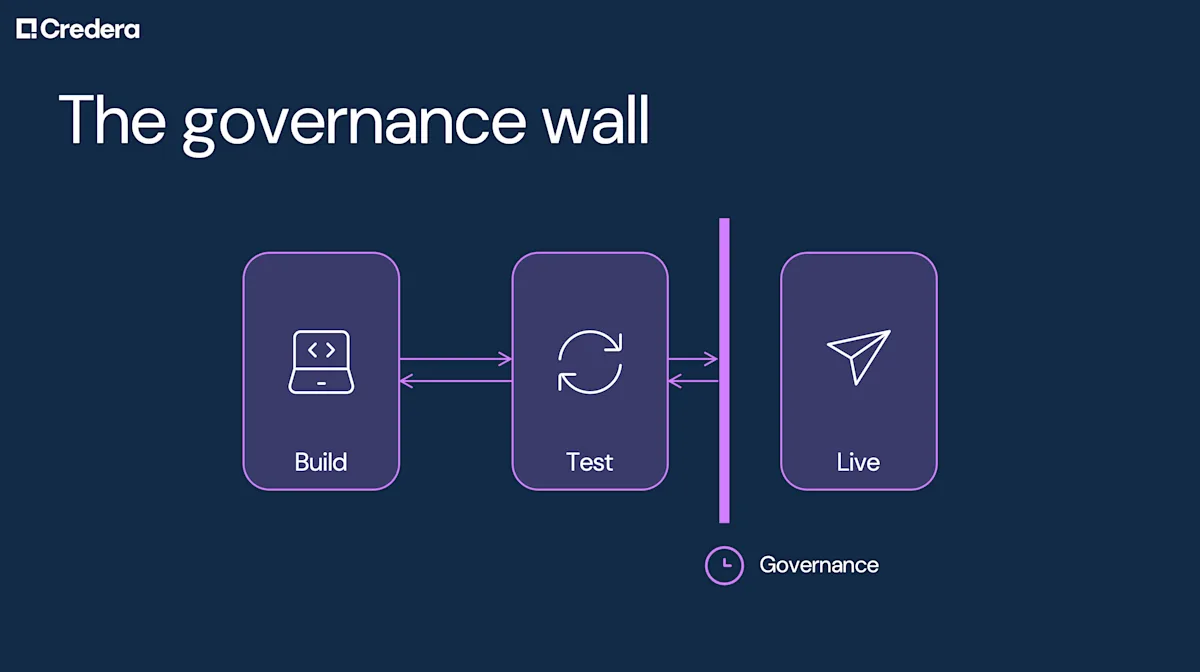


The typical cycle looks like this: teams build and test iteratively, only to hit a bottleneck when every environment, resource and pipeline needs bespoke checks from governance and security. This is especially painful when every team has set things up differently, turning each deployment into a unique audit.
Rethinking governance as an enabler, not a hurdle
One of the most effective ways to overcome these challenges is to embed governance and compliance into the earliest stages of technology delivery. Rather than treating governance as a final hurdle, forward-thinking organisations build it directly into the development process.
This is where concept like the “Internal Developer Platform” (IDP) comes in. When we say IDP, we mean a central platform (for example, portals like Backstage or Port) that gives developers everything they need to build and deploy: environments, pipelines, patterns, and controls, all in one place. No more chasing down access from multiple teams.
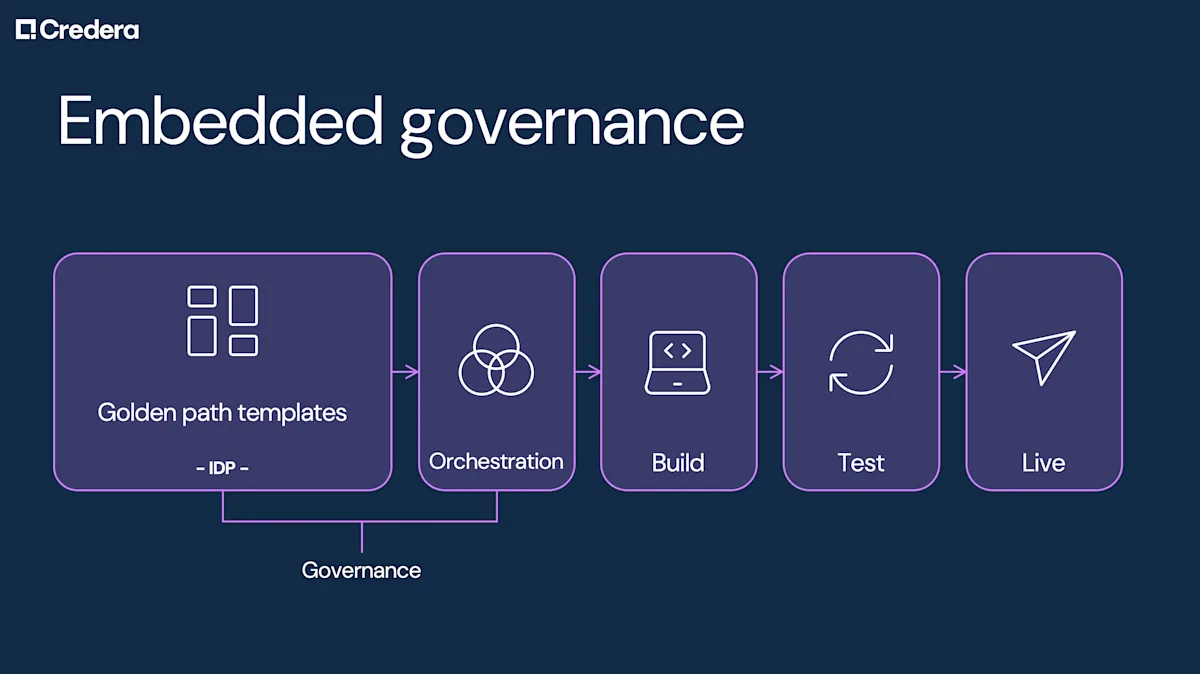

This also involves the use of “golden path” templates — pre-approved, production-grade patterns for infrastructure and applications that already meet strict security and compliance standards.
With these templates in place, engineering teams can start from a trusted baseline, ensuring every project aligns with organisational requirements from day one. Automated orchestrators manage complexity behind the scenes, making it possible to deploy fully governed environments in minutes, rather than weeks or months. By managing risk up front, governance becomes an integrated part of delivery, reducing friction and accelerating time to value.
Governance as code
A transformative step is to turn governance policies from static documents into living software. By codifying policies and embedding them in the platform, organisations ensure that guardrails and controls are enforced automatically for every deployment. This approach eliminates manual checks, standardises compliance and provides a fully auditable process.
A side benefit of this consistency is the ability to create catalogues of reusable accelerators. Templates for machine learning, computer vision and other AI use cases that teams can adopt with confidence. This not only speeds up innovation but ensures that solutions are secure and compliant by design.
For a quick overview of how this works in practice, watch James Milward explain how governance as code and automated guardrails can turn compliance from a roadblock into an accelerator for innovation:
Creating a culture where AI can thrive
While technology and governance provide the foundation for safe, scalable AI, organisational culture is often the deciding factor in long-term success. The companies that advance most rapidly are those where teams feel safe to experiment, where rapid iteration is encouraged, and where failure is viewed as a necessary step in learning.
By providing clear boundaries and predictable governance, organisations enable teams to innovate freely, knowing they operate within a safe and compliant framework. This psychological safety is key to unlocking creativity and driving progress, making innovation a natural part of the business.
Four key lessons for regulated enterprises
For regulated enterprises looking to accelerate AI adoption without sacrificing trust or compliance, a new approach is needed. Here are four key lessons that can help organisations move faster.
Lesson 1: Integrate governance early
Make compliance and risk management foundational, not an afterthought. This will reduce bottlenecks later in the process and allow teams to innovate confidently, knowing that every step is aligned with internal and external standards.
Lesson 2: Automate and standardise
Use pre-approved templates and orchestrated deployments to build data pipelines with built-in auditing and data masking. This means sensitive data can be accessed for AI training through automated, policy-driven approvals, delivering data much faster while maintaining compliance.
Lesson 3: Adopt governance as code
Move away from static documentation and embed policies directly into your technology platforms. This ensures that every project or data pipeline adheres to the same standards and enables the use of reusable accelerators that are secure and compliant by design.
Lesson 4: Foster a culture of safety
Encourage experimentation through clear guardrails and support for rapid iteration. By providing teams with predictable governance frameworks and psychological safety, you create an environment where trying new approaches and rapid prototyping are encouraged.
By applying these principles, organisations can break through traditional barriers and unlock the full potential of AI in even the most demanding environments.
Topics discussed at FIMA 2025 reinforced the idea that regulated enterprises can move quickly and safely by transforming their approach to governance, automation, and culture.
If your organisation is looking to unlock the full potential of AI while maintaining trust and compliance, reach out to Credera to discuss how we can help you achieve scalable, secure AI adoption.

Video
Nov 26, 2025
Modernising legacy systems: How Santander achieved seamless digital transformation
Recognising the limitations of legacy back-office systems, Santander launched a multi-year programme to modernise its...

Blog
Feb 10, 2025
Mastering innovation: A structured path to success
Innovation is the lifeblood of sustained business performance. Yet, despite its importance, many firms struggle to innovate...

Contact Us
Let's talk!
We're ready to help turn your biggest challenges into your biggest advantages.
Searching for a new career?
View job openings

