


Key takeaways:
Pilots should be judged against the business claim: If success means "faster time-to-market," the test must include the people and decisions downstream of the tool, not just the isolated task.
A faster or better output at one step won't speed up the overall workflow unless the handoffs to the next team are also redesigned. The "wall" appears when the next team must rebuild context before continuing.
At every stage in the workflow, someone needs clear ownership and authority over the outcome across handoffs, since connected AI can carry context and flag issues, but final approval and next-step decisions remain human responsibilities.
The brief is finished. It took minutes to produce, and the marketing team agrees the AI has done a useful job. Then it goes into the same queue as every other brief.
The person writing the brief had an easier time creating it, but the next steps remain exactly the same.
This is one of the reasons a convincing AI demonstration can lead to a disappointing business result: The demonstration measures a task, but that productivity gain is isolated from the surrounding work.
Not every valuable use case needs a connected workflow, since a private research aid or a summarization tool may deliver enough benefit on its own. But that distinction deserves more attention before the next AI pilot gets declared a success or a failure.
Giving the pilot a fair, demanding test
An AI pilot can't resolve every organizational dependency before anyone learns whether the technology is useful, but an essential downstream handoff belongs in the experiment when the value claim depends on it.
If the claim is "Reduce the effort required to write a first draft," measure that honestly, but if the claim is "Get campaigns to market faster," you have to include the people and decisions between the draft and activation.
That means naming the person who receives the output, establishing what makes it acceptable, and observing whether they use it. It also means understanding which inputs must be current and who can resolve an exception. These are practical design requirements.
The evidence for looking beyond the tool is broader than this example. In its March 2025 survey analysis, McKinsey found that workflow redesign had the strongest association with reported generative AI EBIT impact among the 25 organizational attributes examined. This is an association from survey data, not proof that redesign alone causes financial returns, but it supports testing the surrounding work alongside the technology.
For marketing leaders, the implication is concrete: Someone needs to own the outcome across the handoffs, with enough authority to bring the relevant stakeholders into the design. Otherwise, each team is optimizing its own contribution while the campaign remains difficult to move.
Finding the wall
The wall appears when a useful capability reaches the edge of its task, and the next team has to rebuild the context before work can continue.
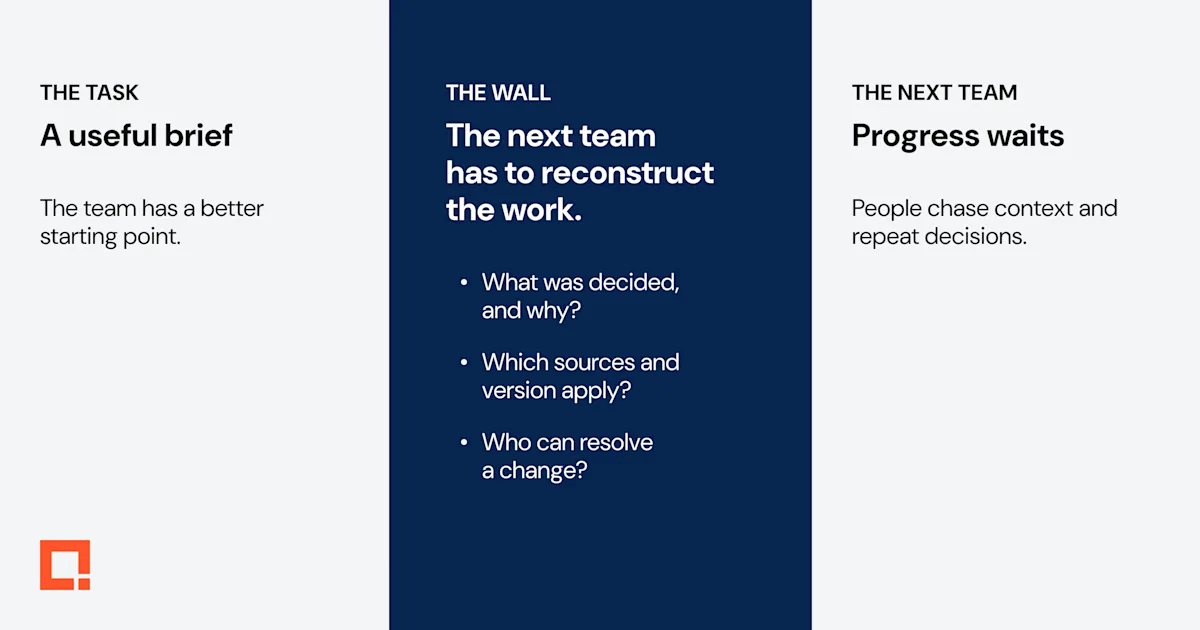


While the original improvement still counts, the opportunity is there to carry it further. Our work across three engagements shows the progression:
Improve the brief.
Build a shared system around briefing.
Connect workflows so one can pick up where another leaves off.
1. Improve the brief.
Our pharmaceutical brief-builder work began in 2024, creating capabilities that made the work substantially faster and better. In one engagement, time to a first draft fell from more than 4 weeks to 2 to 5 days, and we saw much higher-quality briefs. That was real value.
It worked from the marketer's objective, audience, and relevant brand material. Source references sat alongside the draft, and marketers could inspect and revise its sections. Governance was part of the design: The material behind a recommendation needed to be inspectable, and marketers needed control over what they carried forward.
But success there brought the next question into focus: What happens when the brief reaches the next team? Can they use the objective, source material, and decisions already made, or do they have to piece the background together again?
The lesson: Capture the task-level gain, then name the next action the output needs to support.
2. Build a shared system around briefing.
In a subsequent telecom engagement, the teams described several challenges:
Briefs changing after they reached partners
Uncertainty about when to contribute
Different versions of the same information
So we built a shared briefing system in which the brief stayed connected to the campaign's goals and background and teams could develop and review the work together.
People could inspect sources, leave feedback on specific sections, and follow the changes that shaped it, with permissions determining who could view, comment, or edit. Then the next person had access to the current brief and its history, rather than an isolated document they had to make sense of alone.
Usage counts alone wouldn’t show whether the system improved the work, so the rollout plan proposed measuring time spent briefing, revising, and seeking approval, as well as how easily work passed between teams.
The lesson: Keep teams working from the same brief, with its context intact and clear responsibility for what happens next.
3. Connect workflows so one can pick up where another leaves off.
In another pharmaceutical engagement, we built and chained together four agentic workflows over eight weeks: creative briefing; asset generation; support for medical, legal, and regulatory review; and an insights layer covering brand strategy and content effectiveness. It was built for and ran against two of the client's brands, and brief creation moved from days to minutes.
The creative brief carried forward the selected strategic direction and identified findings from the content-effectiveness workflow. It also recorded the supporting source and human validation of the direction.
Asset generation read the same brief and the same approved-claims library, so the language in the banner came from the source that governed the brief. The review workflow flagged unsupported claims and missing safety information for specialists to assess. That assistance supported human review; it didn't give approval to publish.
The approved claims and templates sat in one layer every workflow queried, rather than inside each tool. This made the system tangible because the next piece of work could use decisions already made. What stayed outside the chain was the formal submission and production handoff that follow human approval.
The lesson: The next piece of work should inherit the relevant context and review decisions, with clear authority over what happens next.
The bottom line
When a pilot promises value beyond its own task, follow its output across one real handoff to see what the next person can use and what they have to rebuild. That will tell your team the specific problems they need to solve.
If it feels like your AI pilots keep hitting a wall in demonstrating the expected business value, schedule a call with our team to talk about closing the gap between AI-fueled productivity and faster progress.
And keep an eye out for our next article, which will explore how to design marketing workflows when inputs, decisions, and exceptions keep changing.
Note: Mackenzie Knapp will deliver the opening keynote (“What Work Looks Like When AI Has an Operating System”) at the Iowa State Business Analytics Symposium on Oct. 15 in Des Moines.

Blog
Jun 12, 2025
Who owns your organization’s AI strategy?
Those who seize the opportunities presented by AI will emerge as leaders in an AI-driven future. Here’s how your...

Blog
Jul 30, 2026
Keys to success in realizing your AI initiatives
If your organization is having a tough time bringing AI initiatives to life, especially in a meaningful way, you’re not...

Blog
Jun 3, 2025
Retooling for the future: AI’s role in reshaping tomorrow’s workforce
As businesses move toward AI-integrated systems, one crucial question will shape the transition journey: Who is responsible...
Contact Us
Let's talk!
We're ready to help turn your biggest challenges into your biggest advantages.
Searching for a new career?
View job openings

