


Key takeaways:
Better models won't set you apart. Every competitor can use the same models on Amazon Bedrock. The advantage comes from an AI system that knows how your business works.
Agents disagree because the business hasn't decided how to settle it. Two agents can use identical data and still give conflicting answers. One may use last-touch attribution and the other a media-mix model, and nobody has said which one finance trusts or who signs off. A semantic layer, such as the SageMaker Catalog business glossary, gives agents agreed definitions.
The same principle applies across company lines. When your agents work with an agency's, a short "semantic contract" can set what key terms mean, how they may be used, and what evidence comes back. AgentCore Gateway and AWS Clean Rooms can support this without sharing raw data or tech stacks.
Start small, and measure. Pick one decision that matters and build on the AWS services you already run. Own your definitions, borrow specialized agents, and buy only to close a gap you can name. Judge each agent on correctness, permissions, traceability and consistency. Each project leaves definitions the next one can reuse.
Let’s say the marketing team for a consumer products company with brands in a dozen markets has built a few AI agents on Amazon Bedrock:
One reports on campaign performance.
One looks for new audiences.
One proposes where next quarter’s budget should go.
They run on strong foundation models and can all query the same Amazon Redshift warehouse.
All looks great until the first budget review, when the performance agent calls a summer snack campaign in Mexico a success but the budget agent wants to pull its funding.
Someone spends two days tracing why, and the answer turns out to be mundane: One agent used last-touch attribution, while the other used a media-mix model. Nobody had told them which one finance trusts, whether this quarter’s return outranks new customers, or who signs off before money moves.
Each recommendation made sense alone, but together they gave the marketing lead two confident, incompatible answers and a reason to doubt both.
A better model wouldn’t have helped because every competitor can call the same models through Amazon Bedrock anyway. What’s hard to copy is an AI system that knows how your business works.
That’s where we expect the next real advantage to come from.
Where the disagreement comes from
Most companies keep business knowledge in pieces: a metric defined in one dashboard, adjusted in a SQL script or an AWS Glue job, overridden in a spreadsheet, and fully understood by maybe three people. Employees cope by asking those three people, but an agent usually can’t do that, so it has no reliable way to tell a certified number from a workaround someone built years ago.
For a long time, this was tolerable. Two dashboards disagreed, an analyst reconciled them, and the quarterly deck went out a day late. The problem here is that once agents act on their own conclusions, a mismatched metric can move budget before anyone notices.
Definitions are only one source of trouble, though. It helps to separate three kinds of alignment agents need:
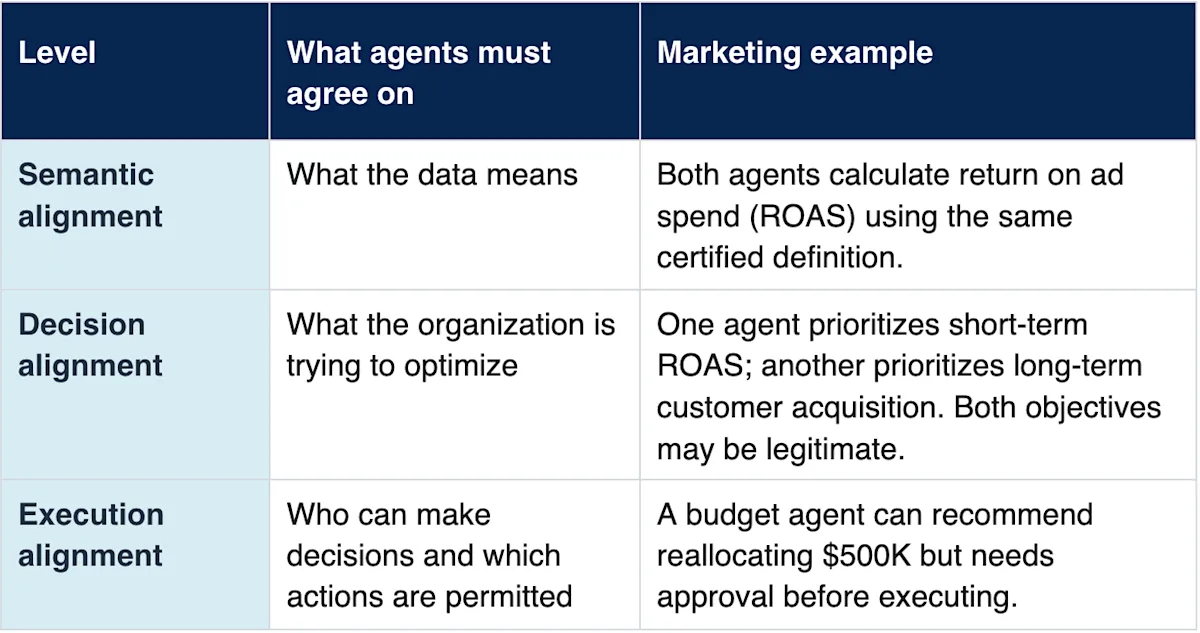


Semantic layers handle the first row. A semantic layer sits between raw data and the people, and now agents, who use it. It holds the agreed definitions: what revenue means; how regions roll up; which customers count as active.
BI teams have relied on them for years, in tools like Amazon Quick. The newer job is serving those definitions to AI systems in a form they can look up and cite. On AWS, that’s already happening: The business glossary in Amazon SageMaker Catalog now feeds SageMaker Data Agent when it writes queries.
Objectives, approval limits, and accountability mostly live elsewhere—in policy engines such as Amazon Bedrock AgentCore Policy, in workflow tools such as AWS Step Functions, and in ordinary approval chains. They don’t all need to move into the semantic layer, but they do need to be written down somewhere an agent can check.
The crux of the problem is that teams tend to miss the second row. Two agents can work from identical numbers and still disagree, because each is doing what it was asked. The real gap is that nobody decided how to settle it.
Resolving decision alignment: Start with one decision
Things get harder when agents cross company lines, such as a media agency’s agent working with yours. Neither side should need the other’s tech stack or full data access, just a short agreement on what key terms mean, how they may be used, and what evidence comes back with an answer. We call this a semantic contract.
On AWS, the pieces already exist: AgentCore Gateway can expose your approved definitions as tools the agency’s agent can call, and AWS Clean Rooms lets both sides analyze shared campaign data without handing over raw records.
None of this requires a multiyear program.
We suggest four steps:
Pick one decision that matters. Choose a workflow where poor context already holds AI back, and write down the metrics, objectives, decision rights, policies and evidence it depends on.
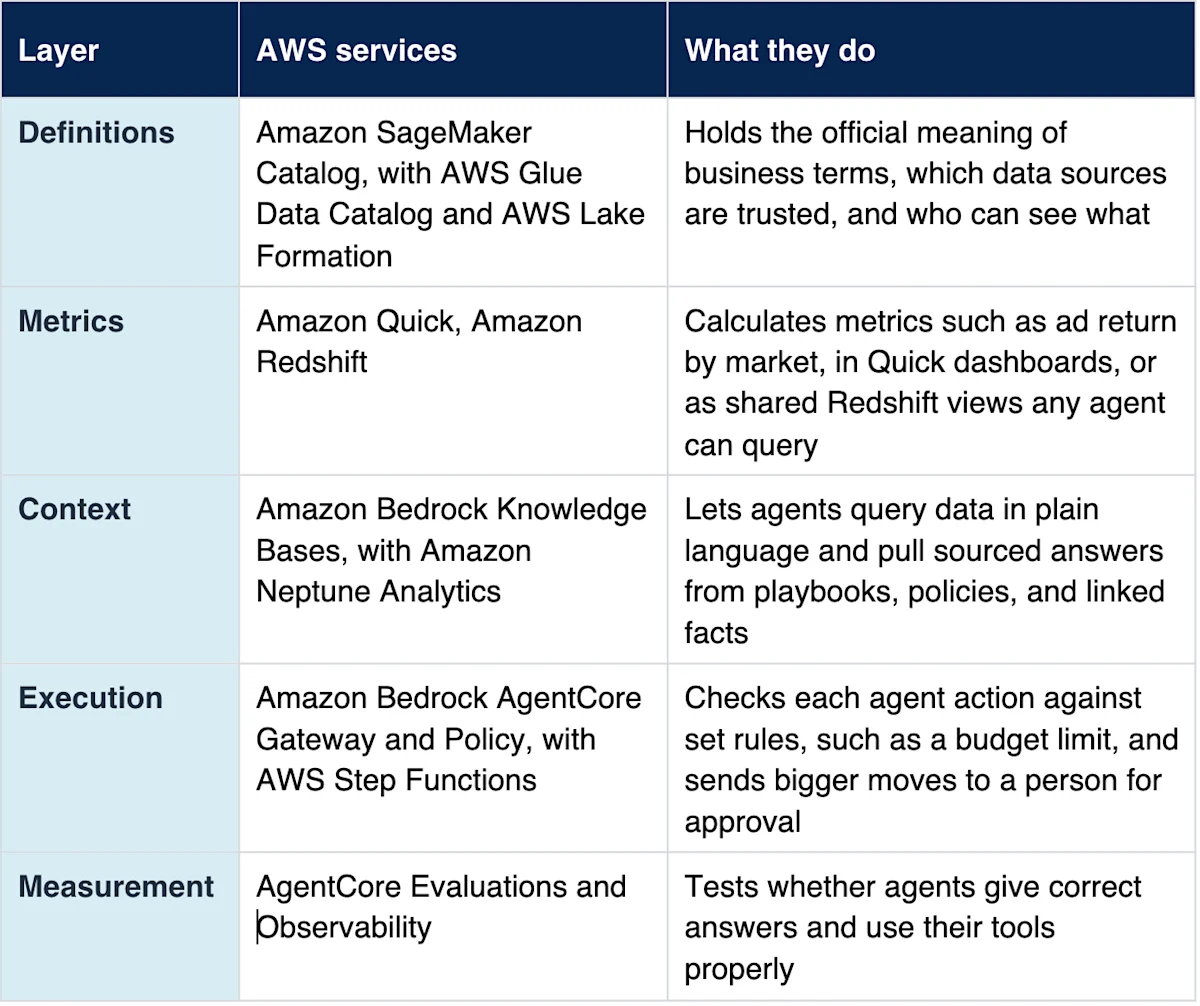
Start with the AWS services you already run. If your data sits in Redshift or an Amazon S3 lakehouse, AWS Glue Data Catalog and Lake Formation are probably in place, and SageMaker Catalog can add business definitions on top.
Own, borrow, and buy. Keep control of your definitions, certified metrics and domain knowledge. Borrow specialized agents, including partner agents in AWS Marketplace, where they beat what you’d build, and only buy new platforms to close a gap you can name.
Measure the results. Judge each agent on four questions: Was the answer correct? Did it stay within its permissions? Can it show which data and definitions it used? Does it give the same answer when asked again? AgentCore Evaluations scores answers and tool use against reference answers, both before release and on live traffic, and AgentCore Observability keeps a trace of each step.
Each project leaves behind definitions the next one can reuse.
With AWS, you can record these in SageMaker Catalog or a Bedrock knowledge base where agents can retrieve them, and turn firm limits, like the $500K approval threshold, into AgentCore policies.

The bottom line
Models will keep getting better and cheaper, and Amazon Bedrock puts most of them a single API call away, so simply deploying AI won’t set anyone apart for long.
Connecting it to what your company knows, including its definitions, priorities, and rules about who decides, is slower work and much harder for a competitor to copy. The semantic layer is an important piece of that.
Schedule a call with our AWS specialists to make sure your AI agents know what they need to about your business before taking action.

Blog
Nov 4, 2026
AI raises the stakes for automotive marketers. Here’s where to start.
OEMs, dealers and lenders need shared rules before AI can act. Explore data strategy consulting to shape your enterprise...


Blog
Oct 20, 2026
Omnicom's Credera Announces Five-Year Strategic Collaboration with AWS to Transform...
Credera today announced a five-year strategic collaboration agreement (SCA) with Amazon Web Services, Inc. (AWS) to help...

Blog
Jun 17, 2026
The future of enterprise marketing is here: Agentic, orchestrated, and built to...
Omnicom, Adobe, and AWS are partnering to deliver agentic orchestration through a unified platform purpose-built for...

Contact Us
Let's talk!
We're ready to help turn your biggest challenges into your biggest advantages.
Searching for a new career?
View job openings

